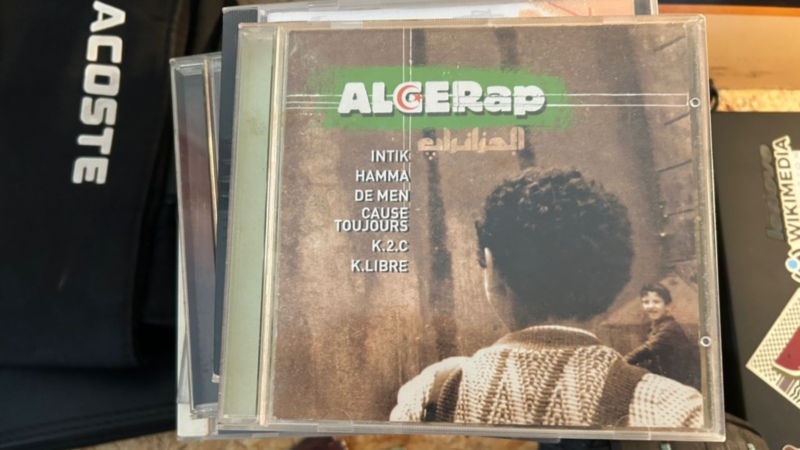
This initiative follows a foundational meeting held the previous year, during which issues related to memory, loss, and archiving within the Algerian Hip Hop scene were raised. This year, the transition from reflection to action materialized through the implementation of concrete tools and approaches aimed at building a comprehensive digital archive of Algerian rap, capable of preserving its productions and reintegrating them into the national cultural narrative.
The program opened with a workshop led by Malik “Fada Vex,” focusing on the role of media in shaping rap archives through journalistic coverage, digital platforms, and audiovisual productions. He offered a historical perspective on the emergence of Hip Hop media, emphasizing the dialectical relationship between media visibility and the longevity of cultural impact. According to him, the absence of documentation does not mean the absence of action, but rather its vulnerability to being forgotten. Azpak’s intervention, presented in the form of a “rapper’s report,” provided an analytical reading of his generation’s experience. He addressed the entrepreneurial dimension of rap practice at the time, as well as the conditions under which Hip Hop activity developed—often in a context marked by a lack of support structures. He also referred to what he described as a “missed archival opportunity,” highlighting that many significant experiences and productions of Algerian rap were never documented, leading to the loss of a substantial part of the scene’s cultural memory. Furthermore, he questioned the balance of media within the Hip Hop landscape, pointing out how the weakness or absence of specialized media has impacted both the dissemination and archiving of rap, contributing to a lasting fragility of artistic memory.
The academic dimension was carried by Monst-R (Soheyb Kehal), who presented his ongoing documentary project alongside his Master’s thesis focused on issues of memory, archiving, and documentary production within Algerian Hip Hop. This contribution acted as a bridge between academic research and field practice, notably through the distribution of a questionnaire to participants, used as a methodological tool in his work. He also introduced several upcoming initiatives aimed at documenting and archiving Algerian rap, particularly through wiki-based platforms, under the coordination of activist Mohamed Amine Benloulou, who was also present at the event.
A particularly striking moment was the spotlight on an early example that could be interpreted as a proto-form of rap in Algeria, through the analysis of the track “El Fen” by Aït Meslayen (1976). This piece presents characteristics close to rap structure in terms of phrasing, delivery, and musical production. The original vinyl record was presented before the track was played, launched simultaneously with the beginning of the questionnaire participation, creating a unique sensory experience at the intersection of musical listening and knowledge production.
After a first break, the program continued with a practical workshop on the digitization of audio cassettes, led by Reda, founder of the platform “Cassette K7matik,” which specializes in the digital valorization of Algerian musical heritage. He presented techniques for restoring and converting analog recordings into digital formats, while highlighting his contribution to recovering rare works, particularly in Algerian rap, such as those of the female group “MLG.” This initiative illustrates the importance of individual efforts in preserving archives.
The workshops were punctuated by exchanges and spontaneous interventions, including that of Rabah Donquishoot, who shared key moments from his journey and the experience of the group “MBS,” bringing a valuable oral memory dimension that complements digital archiving efforts.
The highlight of the day came in the final sequence, marked by the official announcement of the launch of the ANRA platform, initiated by Zakaria Akhrouf. He presented in detail the platform’s content and features, designed to collect, preserve, and organize productions related to Algerian rap, including audio recordings, images, videos, and media content. This initiative aims to fill a long-standing archival gap while making these resources accessible to researchers, artists, and future generations.
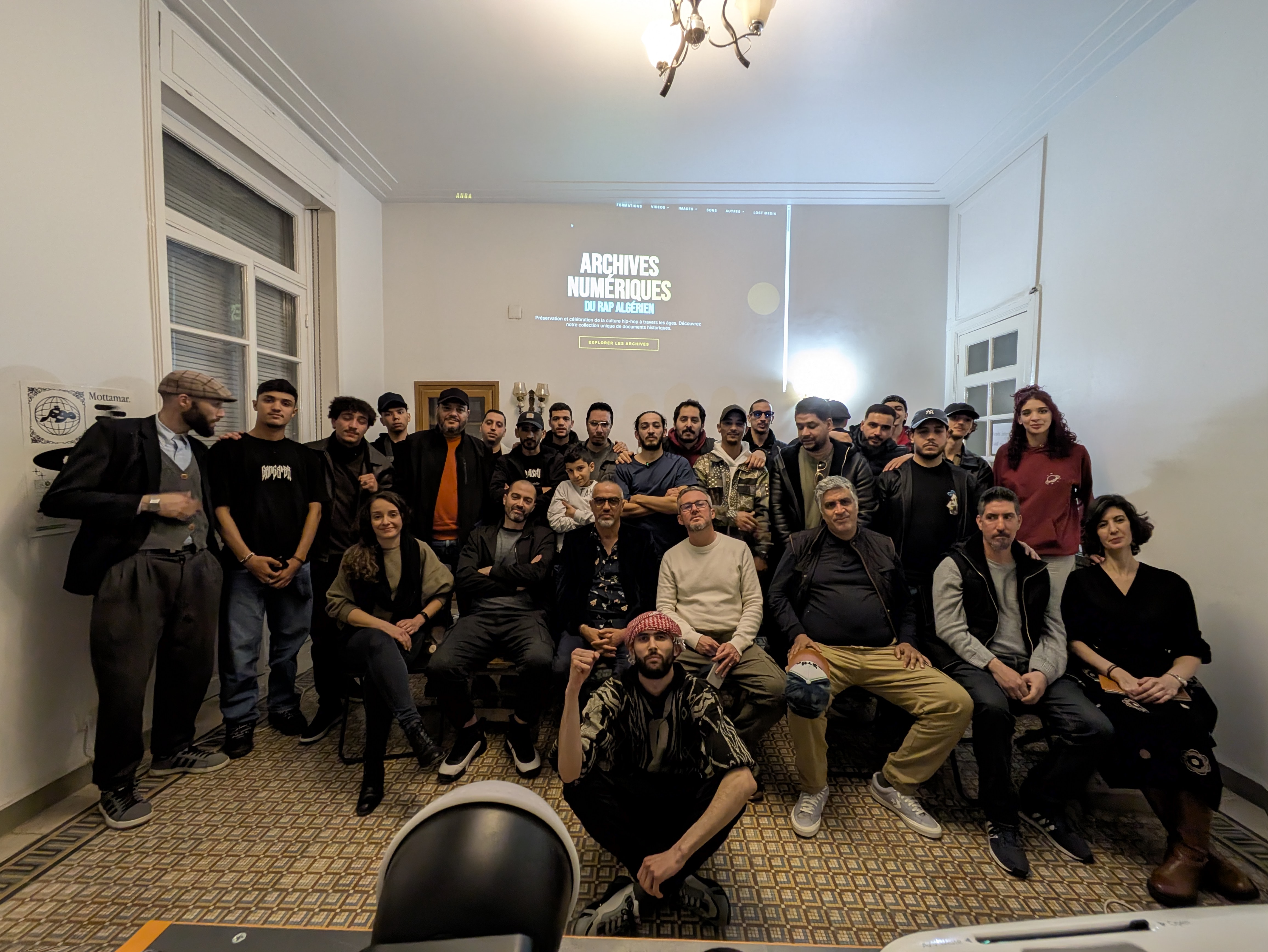
The event stood out for the quality and diversity of its participants, bringing together artists, producers, researchers, and media actors, reflecting the richness and plurality of the Hip Hop field in Algeria. Among those present were Dprod, Red L’Alerte, Diaz, DJ SL, Eazy F, Brahim Derris, Smail Khelwi, Smail Esco, Don Arslane, Adem Akkak, among others. This generational and professional diversity demonstrates the deep-rooted presence of Hip Hop within the Algerian cultural landscape, as well as its ability to unite actors from multiple backgrounds around a shared goal: to share, transmit, and preserve.
Ultimately, this event is part of a broader transformation within Algerian rap, where artistic production alone is no longer sufficient. Awareness around archiving is now becoming an essential component of cultural practice. Between reflection and action, between memory and technology, it becomes clear that the future of Hip Hop in Algeria depends as much on what is created as on what is preserved, structured, and transmitted.
Historical and Cultural Deepening of Algerian Rap
Considering rap solely as a recent phenomenon overlooks its historical and social depth, particularly in the Algerian context. As one of the core elements of Hip Hop culture, rap did not emerge in Algeria as a passing trend, but rather developed within
a specific cultural and historical context, becoming a true means of expressing social and political transformations.
In fact, Algeria is among the first countries in the Arab region and North Africa to have embraced Hip Hop culture, while giving it a distinct local identity and a uniquely Algerian expression. This appropriation is not a simple reproduction of Western models, but a reconfiguration adapted to local realities—in language, themes, and the committed dimension that characterizes this art form.
It is impossible to understand this trajectory without acknowledging the profound influence of the Algerian Revolution, whose global resonance extended to key figures within Hip Hop culture in the United States. Thinkers and activists such as Malcolm X and Muhammad Ali were influenced by Algeria’s liberation discourse, while the film The Battle of Algiers helped shape the consciousness of numerous resistance movements worldwide. Artistically, the 1969 Pan-African Cultural Festival stands as a pivotal moment: Algeria hosted international artists such as Archie Shepp and Nina Simone, as well as engaged figures like Emory Douglas, creating deep connections between artistic expression and political struggle between Algeria and the United States.
From this perspective, the digital archive cannot be reduced to a simple documentation platform, but must be understood as a natural extension of this history. It allows rap and Hip Hop to be repositioned within their legitimate framework—that of a living cultural memory rooted in artistic and activist dynamics. Such a platform can deconstruct reductive perceptions that confine rap to mere youth music, presenting it instead as a documented subject worthy of study within fields such as sociology, cultural studies, and the arts.
Moreover, rap in Algeria carries a philosophical dimension and a critical discourse that engages with fundamental issues such as identity, freedom, and social justice. Its digital documentation thus offers future researchers valuable material to understand the transformations of Algerian society through its artistic expressions. Faced with the challenges posed by artificial intelligence and the acceleration of digital content, such platforms are now an urgent necessity to preserve this heritage and ensure its transmission to future generations. They do not merely conserve works, but also safeguard their contexts, memories, and the identities they carry. In this sense, this digital archive does not simply transform the way Hip Hop is perceived—it contributes to establishing it as a recognized cultural and artistic reference, fully embedded within contemporary Algerian identity.
Article by: Monst-R (Soheyb Kehal) & Mohamed El Amine Benloulou